Safety
MEWP and lift safety
Jeffrey’s resume lists mobile elevated work platform operator and supervisor training for Type 3A and Type 3B. No issuer or class date was printed on that resume, so none is added here.
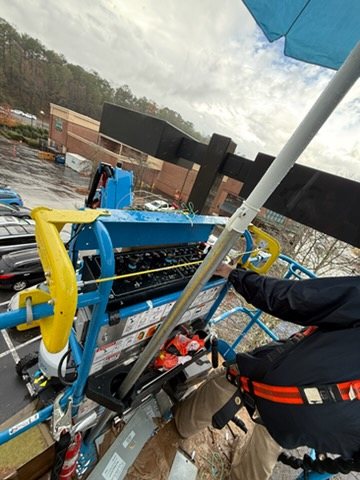
A MEWP is the current name for what jobsites still call a scissor lift or a boom lift. The ANSI A92 series is the design and use standard the industry trains to. A92.22 covers safe use. A92.24 covers training. OSHA still cites aerial-lift rules, including 1926.453 in construction and 1910.67 in general industry. The manual in the weatherproof box on that machine is the procedure for that machine.
Type and group
- Type 3 can be driven while the platform is elevated, and the controls for that travel are on the platform.
- Group A keeps the platform inside the tipping lines. A scissor lift is the usual Type 3A machine.
- Group B can put the platform out past the tipping lines. A boom, telescopic or articulating, is the usual Type 3B machine.
Operator training and supervisor training are different courses. A supervisor is responsible for the people in the machines: the right machine for the site, a rescue plan, and stopping a job that the manual does not allow. Being trained is not the same as being told to run a lift the site has not inspected.
Before it leaves the ground
- Pre-use inspection, from the manufacturer’s list. A leak, a damaged guardrail, or a dead alarm takes the machine out of service.
- The surface has to hold the machine. Grades, drop-offs, covers, and trenches are in the manual’s limits, not in a feeling about the slab.
- Wind, power lines, and overhead steel are looked at from the ground first.
- A harness and lanyard follow the manual. Booms generally require them. Many scissors rely on the guardrails, and some manuals also require a harness. The manual wins.
Power lines
Treat every line as energized until the utility says otherwise. OSHA’s aerial-lift material for electric-power work requires the minimum approach distance for the voltage, an insulated boom that has actually passed its test, or a combination of grounding, bonding, and barricades. For ordinary building work the practical rule is the same idea: the basket, the boom, and the person stay outside the approach distance, and if nobody knows the voltage, the lift does not go closer while someone “checks.” A spotter is how that distance is kept when the operator cannot see the line.
Crushing is the other fatal pattern. A boom pinned against steel, or a scissor rising into a beam, does not stop because the operator is surprised. Controls, a spotter, and not overriding the machine are the controls.
What's happening now
- Use of Aerial Lifts OSHA eTool, electric power generation, transmission, and distribution
OSHA’s requirements when an aerial lift is used near energized lines, including approach distance and what to do if the machine could become energized.
- 1926.959 — Mechanical equipment Occupational Safety and Health Administration
Construction rules for mechanical equipment, including aerial lifts, operated near energized lines.
- Protecting Employees from Electric-Arc Flash Hazards OSHA Publication 4472
The shock and arc-flash boundaries still apply to the person in the basket if the work itself is electrical.
Code section numbers, energy-code rules, and utility practices change by edition and by city. The authority having jurisdiction, and the employer’s written program, decide what applies on a given job.